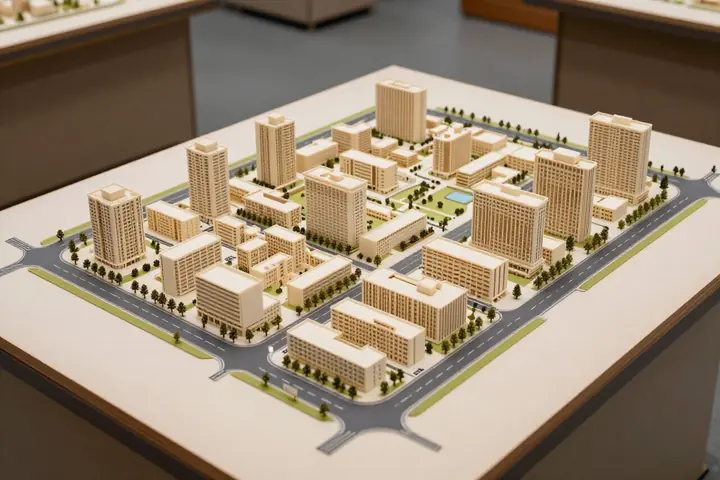
Architectural models
Architectural models translate building form, facade detail and context into a physical presentation. They are used for design review, sales galleries, planning submissions and stakeholder communication.
A sales-gallery model may need different detailing from a design-review model. Clarify the purpose before choosing the scale and finish.
Township and master-plan models
Large-scale developments need a clear relationship between buildings, roads and open spaces. These models show phasing, block identification and landscape priorities.
Large footprints often require modular construction. Ask how the maker preserves legibility at the chosen scale, transports the base and installs it at the destination.
Industrial plant and factory models
These models explain facilities, production areas and plant relationships. They may need to show equipment layouts, pipe networks and process zones, with some systems visible or removable.
Clarify whether the goal is spatial communication or a detailed technical demonstration, and what confidentiality requirements apply.
Interior presentation models
Cutaway spaces make room layouts, materials and furniture relationships tangible. They need small-detail fabrication and practical viewing access.
Agree which furniture is bespoke, which finishes are represented, and how removable elements such as roofs and walls are handled.
Exhibition and presentation models
Display models serve exhibitions, museums, educational settings and public presentations. They may prioritise clarity and durability over tiny detail.
Ask about protective enclosures, assembly, maintenance and repeated transport, especially for venue-specific displays.
Engineering and infrastructure models
Bridges, transport networks and infrastructure concepts become easier to understand as physical models. They can be static, cutaway or technical demonstrations.
Clarify whether the model is explanatory or needs functional behaviour. Defence and technical requirements should use only material you are authorised to share.
Working and demonstration models
Moving and functional models demonstrate mechanisms and processes for technical explanation, teaching and demonstration. Moving features change sourcing needs.
Discuss mechanism design, safe operation, access for servicing and acceptance testing directly with the proposed maker.
3D printing and components
Specialist components and custom elements can support a wider fabrication scope. A printed component is not always a finished model — clarify file preparation, support removal, surface finishing, fitting and assembly responsibilities.
How Vistar helps you choose
Vistar Models helps clients explore the right category for their purpose and considers potentially suitable makers. We do not manufacture these models. Explore the full set of categories we help source, then share your requirement.